Saturday, September 26, 2015

Fireworks

As it happened, while we were in St. Emilion, there was a convention of fireworks manufacturers in nearby Bordeaux. Happpily, there was a demonstration by a Chinese manufacturer in St. Emilion. The town was packed as they set off the fireworks from the old tower. They turned off the street lights in the  town to maximize effect. 

The fireworks were fantastic, as they should be from the land that invented them. They were coordinated with music (not synchronized) and there were varieties I had never seen before. 


The last flurry lit up the whole sky.


A magical night for us, since fireworks have a special significance. 

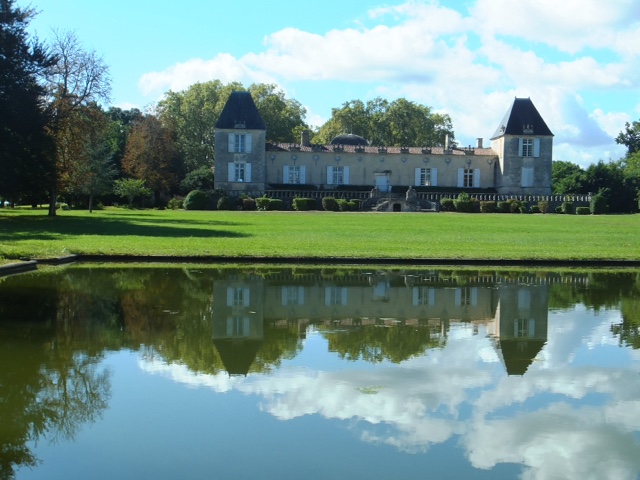
From our B&B in a little village near St. Emilion, we visited Chateau de Sales in Pomerol for a guided tour. The rather pretty chateau is still in use as a home by the family. The owner's family has owned the property since the 14C but they only got serious as winemakers in the 17C,  The owners have many kids and grandkids and 44 great grandchildren and they visit the chateau a lot.   


Everything was humming, as they were about half way through the three-week harvest. The vines were heavy with grapes; we saw these grapes on the way into the chateau and they were picked by the time we came back out.


The pickers (60 of them for this small property) carry these containers on their shoulders


and they are really heavy. After the workers fill the container by cutting the stems with a special knife and throwing bunches of grapes into the container, they walk to the end of the row where the tractor is waiting, climb the ladder, and dump their grapes into a sort of grape trailer. 

The tractors bring the grapes back and the grapes move up a conveyor belt and then down another one into the destemming machine


where (you probably guessed this), the stems are removed


Then the juice gets extracted 


and the juice starts fermenting in concrete containers. As the fermentation takes place, the wine is shifted back and forth between the concrete containers and oak barrels. I was rather surprised at the casual methods of keeping track of things - just chalk on the concrete containers (don't they know these could be easily brushed off by a passing sleeve?)


The record-keeping at the end of the row was also thoroughly non-technical:


The result is about 240,000 bottles of wine of two different labels from this vineyard:


We asked whether workers migrated among vineyards, but the harvests all take place at the same time apprently, even across regions. So what do these people do for the other 49 weeks? Live on unemployment. Wow.

Friday, September 25, 2015

Cave Painting

After visiting Domme, we headed to Les Eyzies to see cave paintings. And met with the greatest disappointment of the trip. In the guide, I'd missed the fact that you have to book ahead and when we got there we were told they were booked up two months(!) in advance. Wow. Crushed. We made the best of it by visiting their wonderful museum on prehistoric man's activities in the area, but both of us were feeling a off and we really didn't do it justice. This was to have been one of the highlights of the trip.

We were rather deflated as we left the B&B the next morning. However, a short distance down the road, I saw a sign announcing Cugnac, caves with prehistoric paintings, at 300 m. off the road. We headed off with extremely low expectations, only to be greeted by a lovely young woman who said we could visit that very day, and in fact a tour was leaving that exact minute with just one other couple. We'd heard tales of people feeling very rushed through these caves, as the carbon dioxide breathed out by a large group can damage the paintings and so they can't stay long in one place. In our case, with a well-ventilated cave and just 4 of us, we could linger as long as we wanted. What a happy couple we were! How lucky we were for the screw-up in Les Eyzies, as we lucked into a better experience.

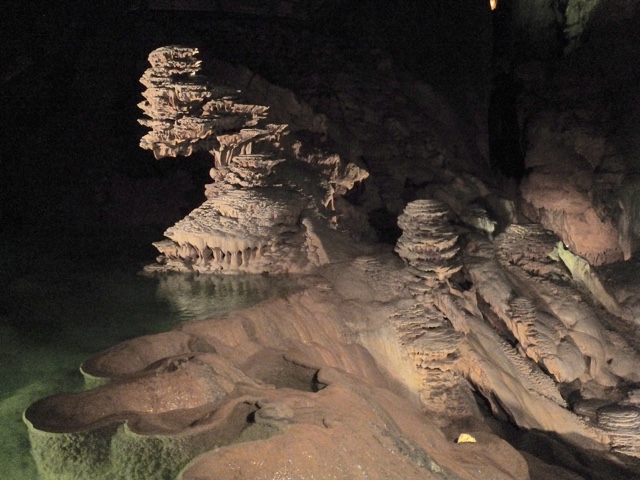
We visited a first cave with some spectacular rock formations, including this unusual shower of stalactities. Neither of us had seen anything like this, even in a book.


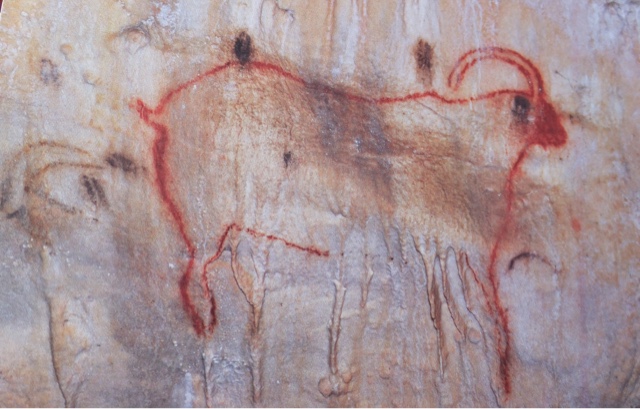
Then on to the piece de resistance, a second cave with the paintings. We walked more 500 metres and then our guide shone a flashlight on some incredible artwork. We were not allowed to take photos, so once again I took pictures of postcards. This animal was quite realistic and instantly recognizable as an ibex.


We had seen a resonstruction of a prehistoric animal called a megosaurus at the Les Eyzies museum and so we instantly recognized these unusual antlers.


The most remarkable thing occurred when the guide shown her flashlight so as to show us how the artist had used the natural contour of the rock to give a three dimensional effect to the animal's back. I was gobsmacked.

These drawing was produced with a different technique than the others.


What is so puzzling about these paintings is that between 30,000 and 40,000 years ago, someone walked a half kilometre through this cave - in the dark - to find rock smooth enough to draw on and then produced these pieces of art, working by torchlight. Amazing.

Even our misadventures have turned out well on this trip.

Thursday, September 24, 2015

Domme and the Dordogne

"Just to glimpse the black, mysterious river at Domme from the beautiful bluff . . . is something to be grateful for all one's life". Henry Miller

I'd have to agree, although the the Dordogne River was blue when we were there. We saw many places to rent canoes alog the Dordogne and you can see a few in the picture, just lazily drifting along with the current, with not much human effect required.


There were pretty manicured fields across the river, further enhancing the scene.


We crossed ad recrossed the Dordogne River many times over the course of several days and rode beside it for many kilometres. Besides Domme, we saw stunning towns perched on the cliffs over the river and pretty houses like these in Miers:


On one of our crossings of the river, we came across this picture-postcard scene in Saint Sozy. (Gosh, I wonder if the next generation will even understand that reference to a postcard?)


In terms of pretty houses, our own B&B was very attractive:


And the meals by the chef-owner not only tasted fantastic, they were gorgeous to behold. How would you like to face this for breakfast?


DInners were even more spectacular but I somehow munched into them before taking photos! On mange bien en France. In fact, a Russian couple we ate with both nights was touring France specifically for a gastronomic tour (especially since sanctions had deprived them of many of their favourite foods).

I loved the Dordogne area.

Food, Food, Food, and Wine

As we've learned from reading the Bruno, Chief of Police series, the Perigord region in the Dordogne is all about food and wine. Duck, fois gras, truffles, nut-base sweets and vin de nois. The main square at Sarlat pays homage to geese, so the priorities are set right from the start. Did I mention fois gras?


We rarely saw geese, but did catch this flock once.


More than geese, we saw constant advertising of their final fate by what I imagine must be the largests producer of fois gras.


We couldn't have had a nicer day to visit Sarlat as the sun shone on the beautiful honey-toned stone buildings, bathing everything in warm light. There were intriguing narrow streets leading off the main square, with medieval buildings still standing. I realized after I took this photo that the front cover of the first Bruno book features almost exactly the same scene.


As you might expect in this land of gastronomy, there are stores galore in the main square and they all celebrate the gourmand delicacies of the Perigord.  Not being a fan of fois gras, this display of all kinds of the area fruit floating in various types of alcohol was particularly enticing.


There were many cafes bustling with tourists:


and many other prety buildings. I particularly loved this view, dappled with sun and shade taken in the main square.


A beautiful place. I'm rereading the first Bruno book to savour once again the pleasures of Sarlat.

Tuesday, September 22, 2015

Our Very Rocky Day

 Our rocky day started with a visit to Rocamadour, a famous medieval pilgrimmage destination on a cliff featuring the chapel of the Black Virgin seen here in the altar.

Pilgrims climb the steps on their knees and there is a stone plaque posted with a list of the 'incontestable miracles' that have occurred here.


We saw a group of GIrl Guiides and Boy Scouts climbing the stairs on their knees - and those are stone stairs!
We experienced our own little miracle. When we first arrived, the church was swathed in cloud. 


Then, as we took the elevator down to the religious complex, sun broke through the mist and we had a lovely day. The church is nestled right into the cliff face with overhangs above:


There were more people attending church than we'd seen anywhere else, and there were more arriving. 


We then went back up to the chateau.


There were lovely views down to the valley below:


A rocky start to the day.  But it was to get rockier still.

On  the advice of friends Barbara and Jim, we next headed to Le Gouffre de Padirac. In this area, a cave roof had subsided, yielding a large crater. We took two elevators down into the crater and we were pretty impressed with its size. Here's looking up.


But then came the exciting part. We started on a walk in the cave following the path of the underground river. We saw some amazing stalagmites and stalactites as we went deeper and deeper into the cavern. "Don't worry', said the guide. "This cave will again implode and form a bigger crater, but that will be 10,000 years from now". Comforting.

Next we were delivered to some boats seating 6 people, with a guide punting us along the underground river (no photos here), taking us ever deeper into the cave. Here is a photo of a postcard (how weird is that?) of the boats:


The experience got ever more eery as we drifted in absolute silence along this river, deep underground. Here we were allowed to take photos (no flash), and I managed to catch a few of the more spectacular sights.


Most dramatic was a cascade of calcified steps, and some 'plate' stalagmites which neither of us had heard of before.


We then left the boats and walked further, up and down stairs. By this point, you have zero sense of direction, except for up and down. Looking at the stairs lit down below gives some sense of the dimensions of this place.


This was an awesome day - rocks in all their form. Yet there was more to come before day's end, as the next post will indicate.

Sunday, September 20, 2015

Amazing Albi

We stopped in Albi mainly because I wanted to see the Toulouse Lautrec Museum and it was a real treat. Many, many salons filled with his paintings, showing his progression as an artist, even some of his notebooks in school with artistic doodles and some early paintings of horses that really didn't look much like horses, Surprisingly, this wonderful exhibit was even free!

The exhibit was housed in the former Palais de Berbiers. Apparently Youlouse-Lautrec's mother offered these works to the Louvre. When they declined, his home town of Albi lucked out.

I was pretty focused on the art at this stop. Wayne said we might as well take a look at the church as well. So we went over my protests that we'd already seen so many churches. Well, thank goodness he pushed, as Saint Cecile is totally amazing.  It was built to project the power and authority of the church after the Albigensian (or Cathar) dissensions in the 13thC. And it's very different from other churches we'd seen.  Firstly it's brick - "the largest brick building in the world", said the audioguide. With the largest organ in France. 


Third, it has a perfectly preserved roood screen. There used to be many of these rood screens dividing the parishioners from the clergy. When that went out of fashion, many churches destroyed their rood screens. Saint Cecile essentially built a second church behind the rood screen, which is why we got to enjoy this:


Lastly, instead of the usual stone, this church is painted on plaster throughout, and has retained its colours well enough that it hasn't had to be restored.  Look at the vibrancy of these colours on one of the wall niches and on the vaulted ceiling.


Thanks to Wayne for the nudge to visit this remarkable church. 

Albi was so interesting because of all the brick, since we've seen hardly any brick in France. On the way out of town, we saw this lovely brick arch


 and this brick aquaduct